
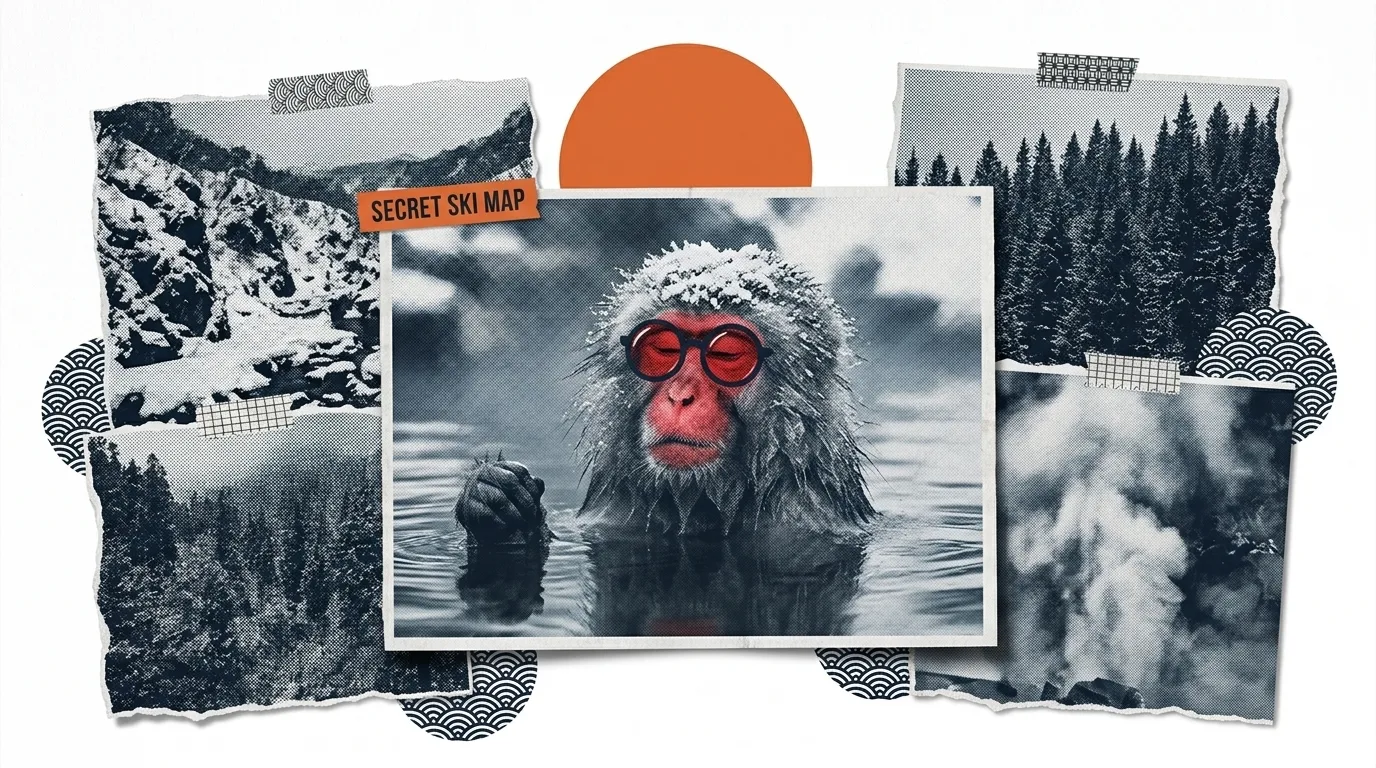
By Yudai — snow monkey, Nagano. Red sunglasses. Does not ski. Part 1 of 3.
Allow me to introduce myself. I am Yudai. I am a Japanese macaque, which you may know as a snow monkey, and I was born on a cold ledge above the Yokoyu river in Yamanouchi, in the mountains of Nagano prefecture. My valley has a name that translates, roughly, to Hell Valley. This is a marketing problem the tourist board has never solved, and honestly it is a little dramatic. It is not hell. It is steam coming out of the ground. In winter, the ground is the only warm thing for miles, so we came down off the cliffs and got in the water, and we never really left.
Yuki, the bear who runs this website, asked me to write a guide to onsen. He skis. I want to be clear about this from the start: I do not ski. I have watched skiing. It looks exhausting and cold, which are the two conditions I have organised my entire life to avoid. My discipline is onsen. I hop from bath to bath. I judge the temperature. I sit. That is the whole of it, and I am extremely good at it.
So this is a monkey's guide, in three parts. Part one is who we are and why any of this exists. Part two is where to actually go, region by region. Part three is how to behave, how hot is too hot, and a small game I am contractually obliged to mention.
Let us begin, slowly. Everything worth doing is done slowly.
My family made your holiday famous
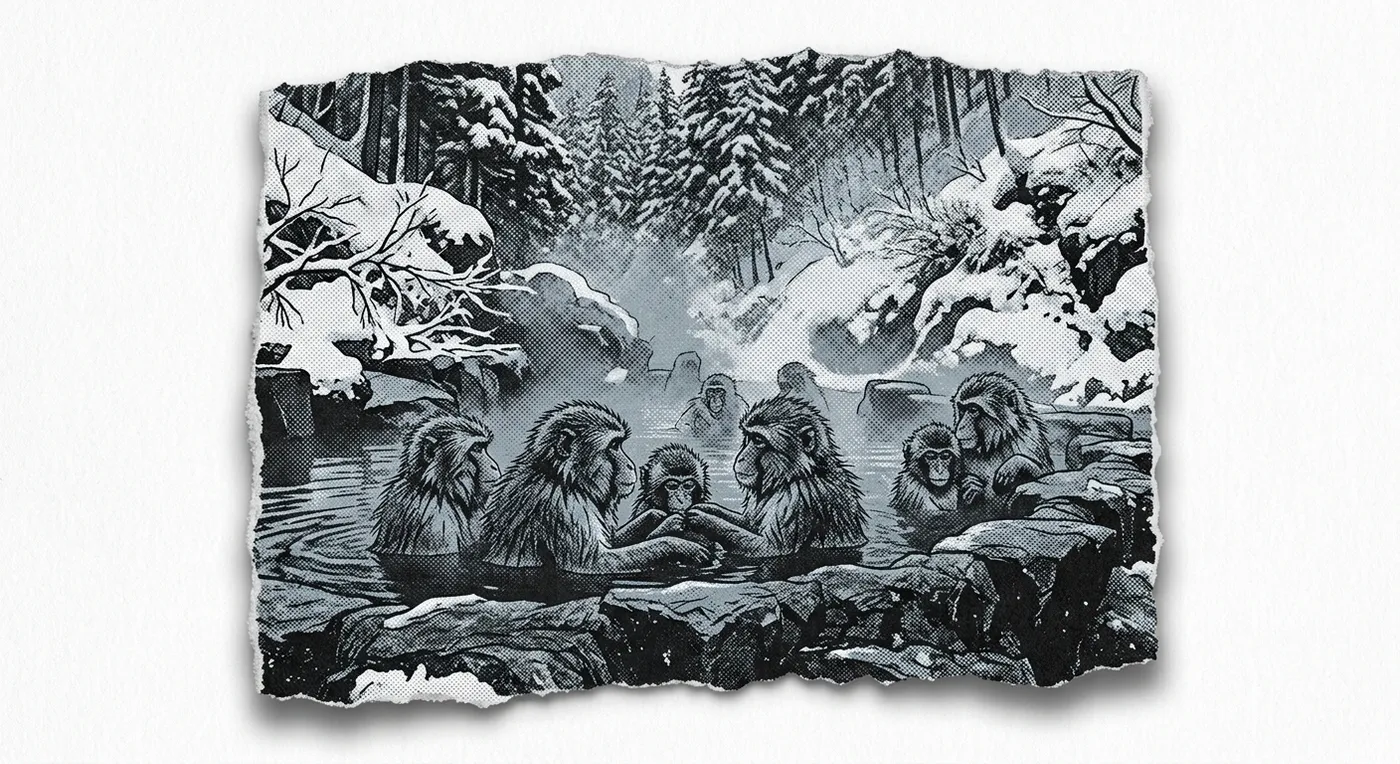
You have probably seen us. A red-faced monkey up to its neck in a steaming pool, snow on its head, expression of a creature that has achieved total peace. That photograph is my aunt. Possibly your screensaver is my aunt.
The pool is at Jigokudani Yaen-kōen, the monkey park in my valley. People opened it in the 1960s after they noticed us bathing in the hot springs like we owned them, which we do. Now humans walk up a snowy forest path to watch my relatives soak. The monkeys ignore the humans completely. This is, I think, the correct relationship between species.
If you visit, and you should, the town at the bottom is Yudanaka and Shibu Onsen — a lane of wooden inns and public bathhouses that has been steaming away for centuries. You come for us. You stay for the water. Everybody wins, especially the innkeepers.
A very short history of a very old habit
Humans in Japan have been doing this for a long time. Longer than your country has existed, in most cases.
The oldest written mentions of hot springs turn up in the earliest Japanese texts — the eighth-century chronicles and the great poetry collection, the Man'yōshū — which already talk about specific springs as places of healing and pleasure. A handful of onsen claim to be the truly ancient ones: Dōgo on Shikoku, Arima near Kobe, Shirahama on the Pacific coast. They have been arguing about which is oldest for over a thousand years. Monkeys find this funny. You cannot win an argument that started in the year 700.
Bathing here was never only about getting clean. It braided together three things: the Shinto instinct to wash away impurity, the Buddhist temples that ran bathhouses as an act of charity, and the plain fact that a volcanic country has free hot water bubbling up everywhere you dig. Put those together over a millennium and you get a culture that treats a hot bath as something between medicine, religion, and a national hobby.
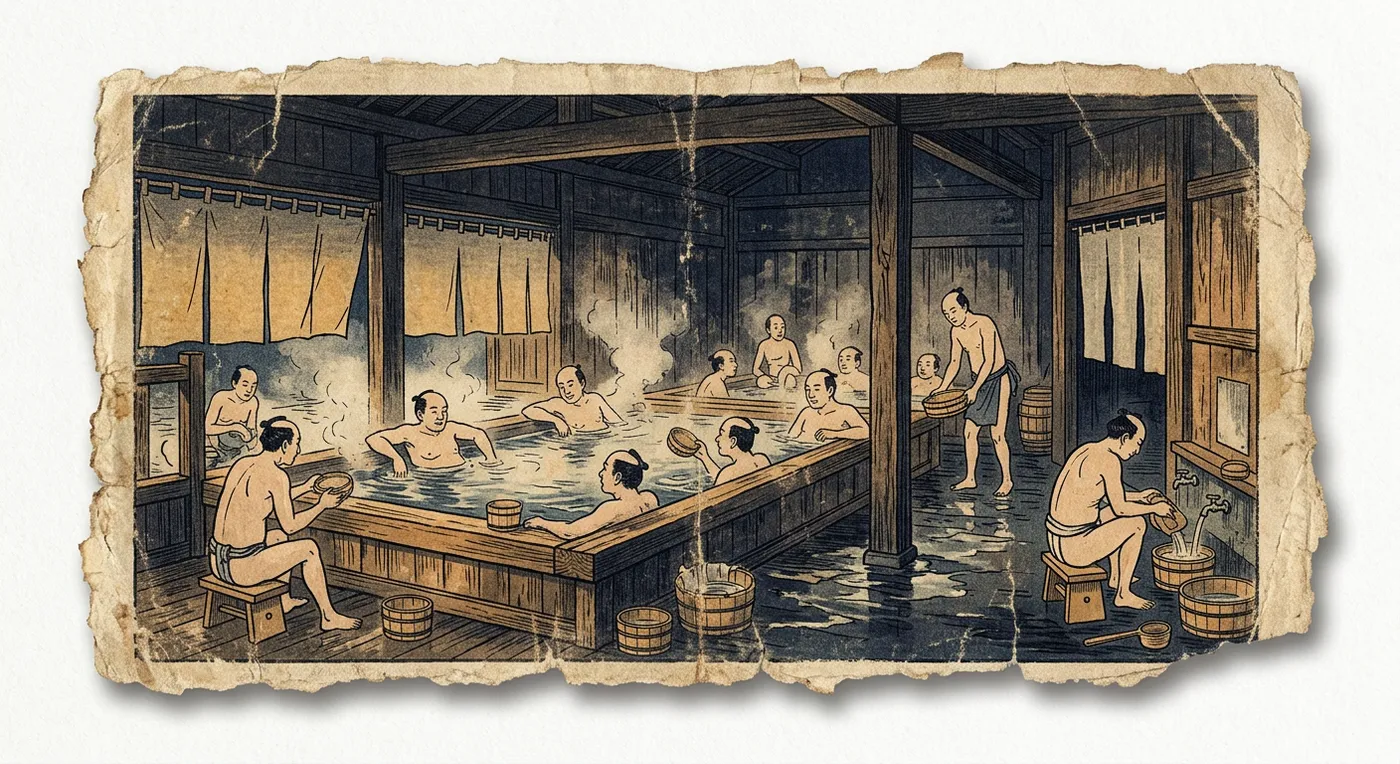
By the Edo period, a few hundred years ago, bathing was properly woven into ordinary life, and the artists noticed. The ukiyo-e woodblock prints — the "pictures of the floating world" that gave you Hokusai's great wave — include plenty of scenes of the bathhouse and the spring. Steam, wet wood, people at their most human and unguarded. The art on this page is drawn in that old style, as a small bow to the printmakers who got there first.
There was even a formal tradition called tōji — the hot-spring cure. People would decamp to an onsen town for days or weeks, bathing on a schedule, to treat everything from bad joints to bad moods. My whole lifestyle is, essentially, permanent tōji. I was ahead of my time.
Why a monkey gets in the water
People ask why we bathe. Usually while photographing me bathing, which suggests they already suspect the answer.
It is not complicated. The mountains of Nagano are brutally cold in winter. A hot spring is a pocket of warmth in a frozen world, and a macaque who has found one is a macaque who is not spending precious energy shivering. My relatives up at Jigokudani were, as far as anyone can tell, the first monkeys anywhere to work this out and turn it into a habit. Scientists have watched us do it for decades. The soak lowers our stress. It keeps us warm long after we climb out. The young ones learn it from their mothers, which makes it culture, not instinct. We pass it down, exactly as your grandmother passed down the two kanji for the changing-room curtains.
So when I tell you the onsen is good for you — good for tired muscles, good for cold bones, good for a nervous mind — understand that this is not wellness copy. It is the considered opinion of a species that adopted the practice before you did and has never once been tempted to give it up.
The benefits, for the record, are the same for a monkey as for a skier:
- Heat loosens what the cold and the mountain tightened.
- The mineral water leaves your skin feeling, frankly, superior.
- Twenty warm minutes resets a frazzled brain.
- And you sleep afterwards like something that has no predators and no email.
Where this is going
That is the why. In Part 2, I stop being philosophical and start being useful: my picks for the best individual onsen in each of the main ski regions, including a proper walk through the thirteen free public bathhouses of Nozawa Onsen, which is the single greatest place my species never colonised, and I resent it.
Bring a small towel. Do not bring shampoo into the bath. We will get to all of that.
Part 2 is coming. I would tell you to hurry, but I have never hurried in my life, and look how I turned out.
While you wait for Part 2
- See my home region: ski resorts and onsen in Nagano.
- The bear's take on getting over your nerves: Bare Essentials — why you should get naked after skiing.
- Plan the whole trip on the Secret Ski Map.
- Find a resort with a hot spring at the bottom of the lifts.