
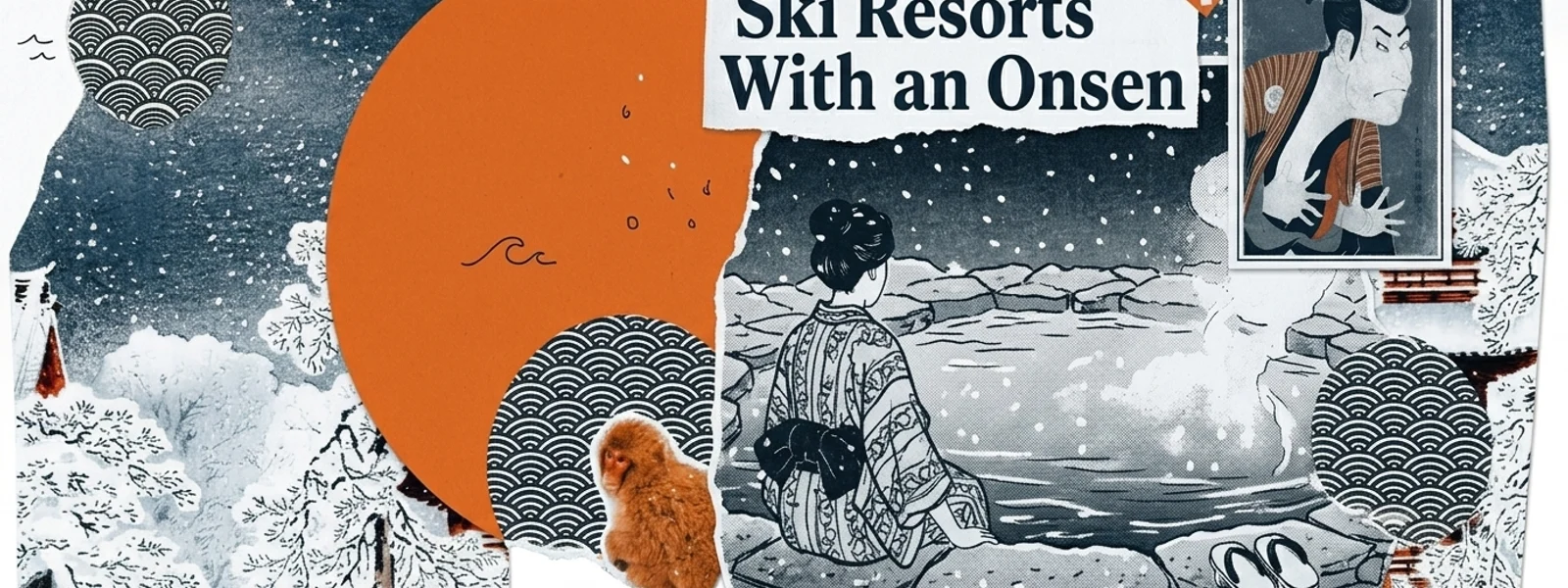
By Yuki — resident bear, Secret Ski Map. Pink, pruned, and counting the resorts with a proper hot spring at the bottom of the runs.
There is a particular kind of ski holiday that ruins you for all the others.
You clip out of your skis at the bottom of the last run. Your legs have filed for divorce. But instead of a car park and a forty-minute drive to a hotel with a lukewarm shower, you walk. Two streets of steam and wooden buildings and the smell of sulphur on the cold air, past a public bath older than most countries, and you are in the water before the light has properly gone. That's not a fantasy. That's Tuesday, if you booked the right resort.
Japan is the only ski country on earth where this is normal. Of the 426 resorts I keep on the map, 301 have an onsen nearby. That's not a marketing number. That's most of them. The mountains here sit on top of a volcanic plumbing system that pumps hot mineral water out of the ground for free, and the Japanese have spent a thousand years building towns around the taps. Skiing turned up later and simply moved in next door.
So this is the flagship guide: which resorts actually put a genuine hot spring at the bottom of the lifts, and which are quietly hoping you won't ask the difference.
What "a resort with an onsen" really means
Here's the bit the booking sites blur, so let me be a blunt bear about it. "Onsen" and "hotel spa" are not the same animal, and the gap between them is the whole point of this post.
An onsen is real geothermal spring water, drawn from the ground, mineral and hot and alive. A hotel spa is a heated pool with a name badge. Plenty of ski hotels advertise "onsen" when what they mean is a tiled tank of warmed tap water on the third floor. It's pleasant. It is not the thing. The thing has a smell, a colour, and a temperature it did not choose.
There's a second axis that matters even more, and it's about where the water lives:
- The onsen town. The rarest and best. The hot springs came first, the ski lifts came second, and the whole village is built around public bathhouses you walk between in a robe. Nozawa Onsen. Zao. Myoko. You don't visit the onsen. You live in it for a week.
- The onsen at the base. A proper spring-fed bath a short walk or shuttle from where you unclip. Not a village, but genuine water and no faff. Most of the Hakuba valley, plenty of Niigata.
- The hotel bath. Fine after a hard day. Just know what you're paying for, and don't confuse it with the first two.
When someone asks me for a "ski resort with an onsen", they almost always mean the first one and don't know it yet. So let me start there.
Nozawa Onsen — the one to beat
If you only trust a bear about one place, trust me about this one.
Nozawa Onsen in Nagano is an actual onsen town with a ski hill bolted on top, not the reverse. It has eight hot springs, and thirteen of them are free public bathhouses called soto-yu, run by the villagers themselves, tucked down lanes between the houses. You wander from one to the next in the evening, steam curling off the streets, and pay nothing. The snow reads High, the day pass is a sane ¥6,900, and you can sleep in the village itself from around ¥5,050 a night.
Getting there is easier than it looks. Take the Hokuriku Shinkansen to Iiyama, then the direct Nozawa Onsen Liner bus, which drops you in the village in about 25 minutes. You can be soaking a few hours after leaving Tokyo.
One evening in Nozawa does something to your definition of a ski holiday. You stop thinking of the bath as the reward for the skiing and start thinking of the skiing as the thing you do between baths. That's the right way round, and you'll never quite go back.
Nozawa is the answer to the question "what does the ideal look like". Everything else in this post I'm quietly grading against it.
The Hakuba valley and Myoko — springs at the base
If you want big terrain and real water, this is your bracket.
The Hakuba valley is a string of resorts up one Nagano side-road, and it's soaked in hot springs. Happo-One is the headline mountain — the 1998 Olympic hill, day pass around ¥7,000, snow High, eight onsen within reach of the base. Down the valley, Hakuba Goryu gives you the same eight-onsen access and beds from about ¥3,465 a night, which is a proper bargain for what you get. The whole valley runs off Hakuba station on the JR Oito line, roughly an hour from the Nagano Shinkansen, with shuttles doing the last leg.
Then there's Myoko, over in Niigata, and I have a soft spot for it. Myoko Suginohara reads Very High for snow — the good, deep, quiet stuff — with eight onsen nearby, a gentle ¥5,800 day pass, and beds from around ¥5,000. The neighbouring Akakura area is the old spa heart of it. It's less polished than Hakuba, which is exactly why I like it. Myoko-Kogen station is about 20 minutes out by bus off the Nagano Shinkansen.
Between them: Olympic-grade skiing, Very High snow, and a hot spring waiting at the end of every day. That's not a compromise. That's having it both ways.
Shiga Kogen and Zao — the specialists
Two more that earn their place for very different reasons.
Shiga Kogen is the biggest linked ski area in Japan, 52 runs of Very High snow, ¥6,500 a day, beds from ¥4,000. It carries only two onsen of its own, so it doesn't win on bathhouse count. It wins on what's next door. You reach it via Yudanaka station, and Yudanaka is the doorstep of Jigokudani — the valley where the wild snow monkeys sit in their own hot spring, pink-faced and steaming, entirely unbothered by tourists. Ski the biggest terrain in the country, then go watch monkeys do the exact thing you're about to do. I've never not found that funny.
Zao Onsen, up in Yamagata, is the other end of the country and worth the trip. It's another true onsen town, eight springs, with sulphur water that's been drawing bathers for centuries, and it has a party trick: the juhyo, the "snow monsters", where whole trees freeze into ghostly white sculptures across the upper mountain. Beds from around ¥4,600. Soak in ancient water, ski through a forest of frozen ghosts. Nowhere else does that.
GALA Yuzawa — for when you can't be bothered
Sometimes you want the water without the logistics. GALA Yuzawa exists for exactly that.
The ski centre is the shinkansen station. You ride the Joetsu Shinkansen out of Tokyo, and about 75 minutes later you step off the platform onto a gondola. No bus, no transfer, no dragging bags through slush. It's a ¥5,900 day pass, snow reads High, eight onsen sit nearby in the wider Yuzawa area, and you can turn a day of skiing and a hot soak into a same-day round trip from Tokyo if you're mad enough. It's not a wild-powder pilgrimage. It's the most civilised way to get snow on your boots and mineral water on your skin before dinner.
One bear's honest opinion
I'll say the thing I actually believe, plainly.
Book the onsen town, not the mountain. Everyone shops for a ski resort by counting the runs and the snowfall, then treats the hot spring as a nice extra. That's backwards. The skiing in Japan is wonderful almost everywhere. What's rare, what you genuinely cannot get at home, is walking out of the water in a wooden village at dusk with your legs feeling twenty years younger. Nozawa, Zao, Myoko — the places built around the springs — will give you a better week than a bigger mountain with a tap in a hotel basement.
So pick the water first. The snow will be there either way. The town that soaks you every evening is the thing you'll still be talking about in July.
Find the hot spring. Then find the hill. Trust the bear.
Keep going
- Want the full list, not just my favourites? Here's every Japanese ski resort with an onsen nearby — all 301 of them.
- Open the Secret Ski Map and see the whole country at once — filter for the springs and plan the trip.
- Not sure where in Japan to point yourself? Start with the regions — Hokkaido, Nagano, Niigata and the rest, side by side.
- First time in the water and quietly terrified? Read Bare essentials: the onsen after skiing — the naked truth, gently explained.
- Timing the trip? See the best time to ski Japan for when the powder and the springs are both at their best.
- Rest day for the legs? There's a small, silly game about hopping between baths. Play Onsen Hop.